前言:史蒂夫谈童年与青年时代
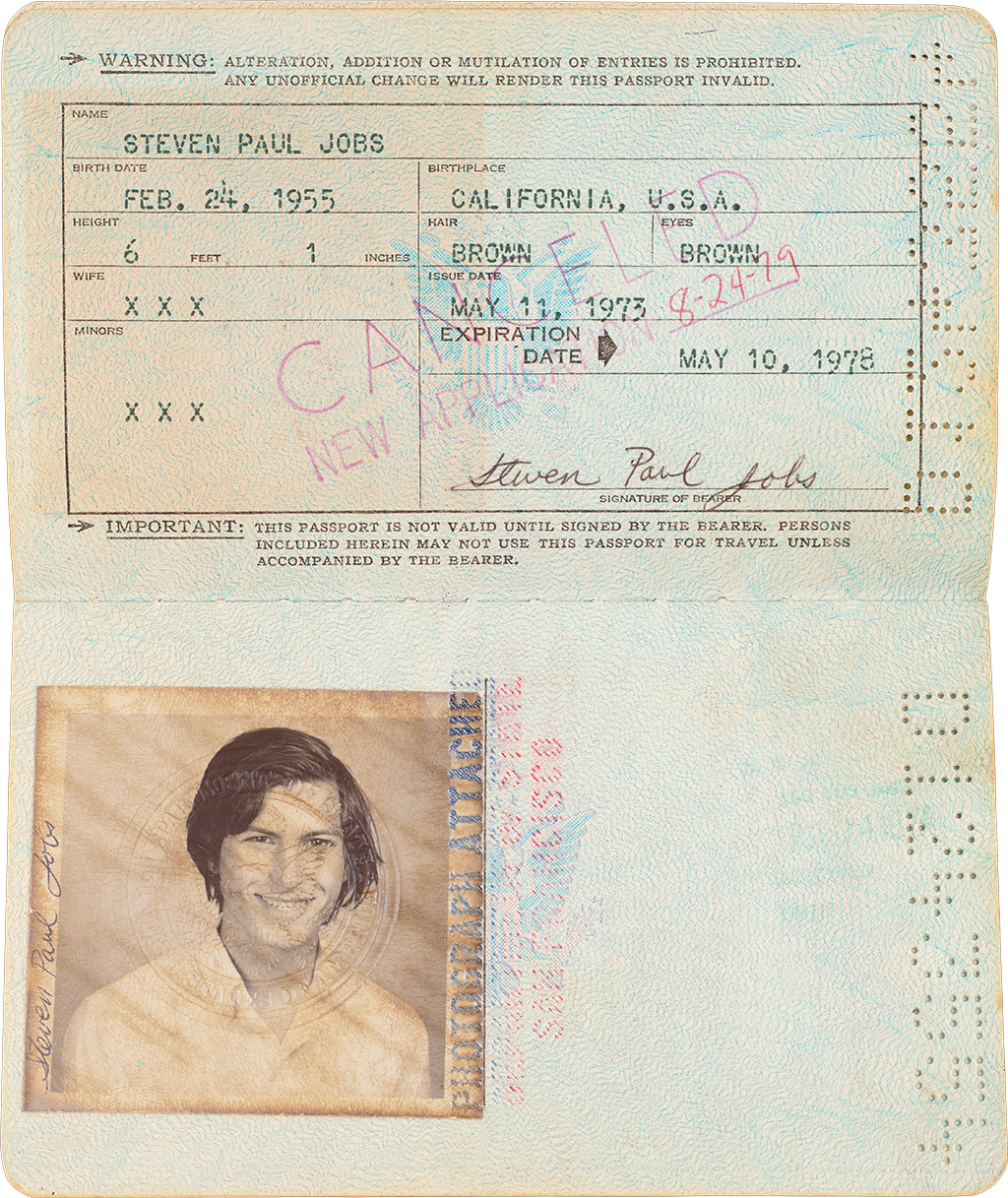
A passport for Steven Paul Jobs issued on May 11, 1973, featuring a stamped photo of him with shaggy hair. 1973年5月11日签发给史蒂文·保罗·乔布斯的护照,照片上是留着蓬松长发的他。
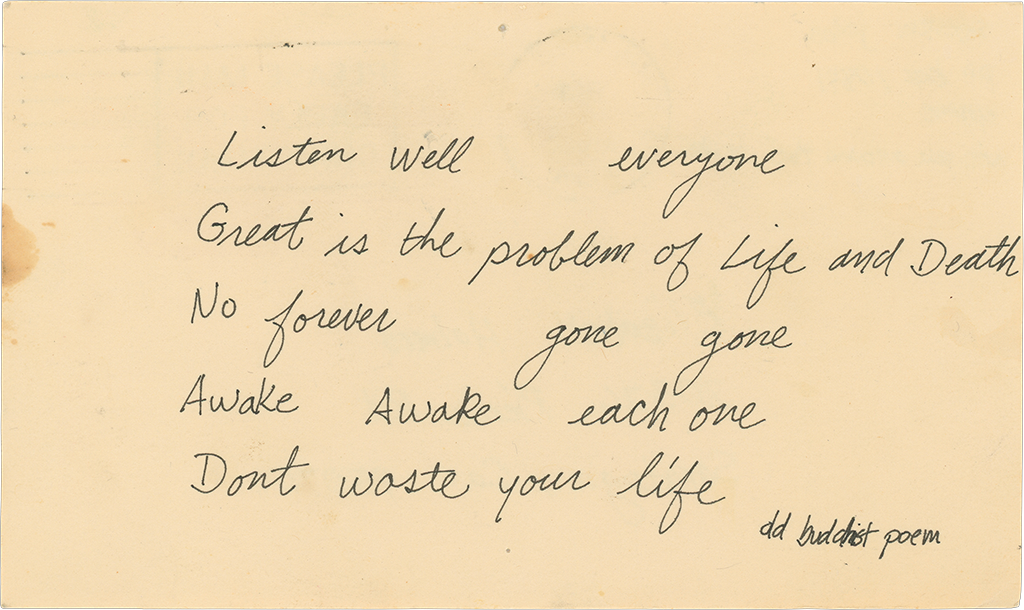
A yellowing postcard with a buddhist poem in Steve's handwriting. Its last line reads: Dont waste your life. 一张泛黄的明信片上,是史蒂夫手写的佛教诗句。最后一行写着:不要虚度此生。
背景: 史蒂夫通常保持私人生活的私密,但偶尔谈到在旧金山湾区长大的经历。那是一个工程师和程序员开始涌入后来被称为硅谷的地方的时代。
核心概念
- 保罗·乔布斯 (Paul Jobs) - 养父,机械师,用双手的天才
- 拉里·朗 (Larry Lang) - 惠普工程师,电子启蒙老师
- Heathkit套件 (Heathkits) - 自己动手组装电子产品,理解事物内部原理
- 希尔老师 (Mrs. Hill) - 用糖果和金钱"贿赂"他重新学习,点燃学习热情
- 里克·费伦蒂诺 (Rick Ferrentino) - 童年好友,一起制造恶作剧
- 阿尔·奥尔康 (Al Alcorn) - 雅达利工程副总裁,雇用乔布斯
- 里德学院 (Reed College) - 就读六个月后退学但继续蹭课
- 雅达利 (Atari) - 第一份工作,视频游戏制造商
- 惠普 (Hewlett-Packard) - 硅谷先驱,沃兹工作的地方
- 动手建立自信 (Self-confidence through building) - 通过组装理解复杂事物,建立自信
- 蒂莫西·利里 (Timothy Leary) - 曾经过里德学院停留的思想家
- 理查德·阿尔珀特 (Richard Alpert) - 曾经过里德学院停留的心理学家
- 加里·斯奈德 (Gary Snyder) - 曾经过里德学院停留的诗人
内容
中文翻译
1995年,他为史密森尼学会录制口述历史
我非常幸运。我有一个父亲,叫保罗,是个相当了不起的人。他高中没毕业。二战时加入海岸警卫队,为巴顿将军运送部队环游世界,我想他总是惹麻烦被降级成二等兵。他是个机械师,工作非常努力,是个用双手的天才。他在车库里有个工作台,当我大约五、六岁时,他划出一小块地方说:"史蒂夫,这是你的工作台了。"他给了我一些他的小工具,教我如何使用锤子和锯子,如何建造东西。这对我真的很有好处。他花了很多时间陪我,教我如何建造东西、拆解东西、重新组装东西。
他触及的一个领域是电子。他自己对电子没有深入理解,但他在汽车和其他他会修理的东西中经常遇到电子。他给我展示了电子的基础知识,我对此非常感兴趣。
我在硅谷长大。我父母在我五岁时从旧金山搬到山景城。我爸爸被调职了,那正是硅谷的心脏,所以周围都是工程师。硅谷,在那时,大部分还是果园——杏子果园和李子果园——那真的是天堂。我记得几乎每天空气都水晶般清澈,你可以从山谷的一端看到另一端。那真的是世界上成长的最美妙的地方。
有个男人搬到街那头,可能离街区六、七栋房子远,他和妻子是新邻居。结果他是惠普的工程师,他是个业余无线电爱好者,真的热衷于电子。他为了认识街上的孩子们做了一件相当奇怪的事:他在车道上放了一个碳麦克风、一个电池和一个扬声器,你可以对着麦克风说话,你的声音会被扬声器放大。当你搬进一个社区时,这是件奇怪的事,但这就是他做的。我认识了这个人,他叫拉里·朗,他教了我很多电子知识。他很棒。他过去常常组装Heathkit。
Heathkit真的很棒。Heathkit是你可以买套件形式的产品。实际上你付的钱比直接买成品还多,如果有成品的话。这些Heathkit会附带详细的手册,教你如何组装这东西,所有零件都会按特定方式摆放并颜色编码。你实际上会自己建造这东西。我想说这给了人几样东西。它让人理解成品内部是什么以及它如何工作,因为它会包含操作原理。但也许更重要的是,它让人有一种感觉,人可以建造自己在宇宙中看到的周围的东西。这些东西不再是神秘的了。我的意思是,你看着一台电视机,你会想,"我没造过那东西——但我可以造。Heathkit目录里有那个,我造过两个其他Heathkit,所以我可以造一台电视机。"事情变得更清楚了,它们是人类创造的结果,不是那些魔法般出现在环境中、人对内部一无所知的东西。它给人巨大的自信,通过探索和学习,人可以理解环境中看似非常复杂的东西。我的童年在这方面非常幸运。
学校一开始对我来说相当艰难。我母亲在我上学前教我读书,所以当我到那里时,我真的只想做两件事:我想读书,因为我爱读书,我想出去追蝴蝶。你知道,做五岁孩子喜欢做的事。我遇到了一种我从未遇到过的权威,我不喜欢它。他们真的差点抓住我。他们差点把我所有的好奇心都打掉。
到我三年级时,我有个好朋友,里克·费伦蒂诺,我们唯一有乐趣的方式就是制造恶作剧。我记得有个大自行车架,大家都把自行车放在那里,可能有百辆自行车在这个架子里——然后我们一对一地用我们的锁组合换他们的。然后有一天出去把每个人的锁都锁到别人的自行车上,结果他们直到晚上十点左右才把自行车都整理好。我们在老师的桌子里放爆炸物。我们经常被赶出学校。
四年级时我遇到了我生命中的另一位圣人。他们打算把我和里克·费伦蒂诺分到同一个四年级班,校长在最后一刻说,"不,坏主意。分开他们。"所以这位老师,希尔太太说,"我要一个。"她教高级四年级班,谢天谢地我是被随机分进那个班的。她观察了我大约两周然后接近我。她说,"史蒂文,我告诉你。我跟你做个交易。我有这本数学练习册,如果你带回家自己完成,没有任何帮助,你带回来给我,如果你做对80%,我会给你五美元和一个这种真正的大棒棒糖。"她买了一个,她在我面前拿出来——这种巨大的东西。我看着她,"你疯了吗,女士?从来没人这么做过!"当然我做了。她基本上用糖果和金钱贿赂我重新学习。而非常了不起的是,不久我就对她有了如此的尊重,这重新点燃了我学习的欲望。她很了不起。她给我弄了制作相机的套件。我自己磨镜头,造了一台相机。那真的非常美妙。我想我可能在那一年学到的学术知识比我一生中任何时候都多。
1984年,史蒂夫与记者大卫·谢夫聊天,谈到他这一代年轻人如何开始发展自己的文化观
我父母从未强迫我上大学,但他们总是想确保如果我想去,他们有资源供我去。他们存钱,他们真的牺牲了一些,存了些钱[供我上里德学院],但[……]六个月后,花他们一生的积蓄供我上大学看起来真的很荒谬。我对我想做什么了解不够,而且,我想我可以退学然后再退回去上课,学到的一样多。所以我六个月后退学,然后又退回去待了一年半。我在那里待了大约一年半,可能接近两年。我非常享受。那是我生命中一段艰难的时光,但我非常享受。
我不知道我想用我的生命做什么。里德是一个非常激烈的地方,非常聪明的人——每个人都想改变世界,但不太知道怎么做。七十年代早期是那种东方神秘主义冲击美国海岸的时候。我们不断有人经过里德,在里德停留。从蒂莫西·利里和理查德·阿尔珀特到加里·斯奈德,这样的人。所以不断有对生活和存在的真理的知识探索。
六十年代的理想主义之风仍在我们背后,我认识的同龄人都永远铭刻着这一点。他们有那种理想主义,但他们也有某种谨慎,关于四十五岁时最终在天然食品店柜台后面工作,这是他们看到一些年长朋友[在做]的——不是说那本身不好,但如果那不是你真的打算做或你真的想做的事,那就不好。所以那种理想主义形成了,但也有这种感觉,必须有更成功的方式[实现]一些那种理想主义。
史蒂夫还回忆起离开里德学院后在加州和印度的时光
我回到[旧金山湾区],因为我决定我想旅行,但我缺乏必要的资金。这是加州。你可以从斯坦福大学买到新鲜制作的LSD。你可以和女朋友及任何有意义的其他人去海滩睡觉。你可以……直到我旅行到那些地方,我才真正意识到加州与美国中部、甚至东海岸有多么不同。我二十出头前从未去过那些地方。加州有一种实验的感觉,一种开放的感觉——开放和新的可能性——直到我去其他地方我才真正欣赏。
所以我回来找工作,我在报纸上看到这则广告[……]谈到做工程师同时玩得开心。听起来很有趣,所以我打电话了。是[视频游戏制造商]雅达利。我填了申请表,只列了我做过的所有事情,人事女士说,"好吧,别打电话给我们,我们会打电话给你!"但某种运气让我的申请到了一个叫阿尔·奥尔康的人手里,他当时雅达利的工程副总裁。他第二天给我打电话雇了我,那很棒。
[……]我在那里待了不到一年,他们运了一批有工程缺陷的游戏到欧洲。我弄清楚如何修理它们,但需要有人过去实际修理。所以我自愿去;嗯,他们问我是否愿意去,我说我当然愿意,但我想在那里请个假。所以他们让我这么做,我最终到了瑞士,从苏黎世飞往新德里。我在印度待了一段时间。
我很惊讶要总结[我的印度之行]。任何人都很难在一页纸上总结他们生命中重要的经历。我的意思是,如果我是威廉·福克纳,我也许能为你做到,但我不是。
回来比去更具文化冲击。我[回到加州后]真正想做的就是去找一片草地坐下。我不想开车。我不想去旧金山或做所有这些事。我不想做。所以我没做,大约三个月。我只是读书和坐着。当你在一个地方是陌生人时,你会注意到你迅速不再注意的事情。我一生中第一次在美国是陌生人,所以我看到了我以前从未见过的东西。我试图在那三个月里注意它们,因为我知道,渐渐地,我会重新获得熟悉感。
英文原文
Preface: Steve on His Childhood and Young Adulthood, Make Something Wonderful

Preface: Steve on His Childhood and Young Adulthood

Steve typically kept his personal life private, but he did occasionally talk about growing up in the San Francisco Bay Area. It was a time when engineers and programmers began flooding into what came to be known as Silicon Valley.

In 1995, he recorded an oral history for the Smithsonian.

I was very lucky. I had a father, named Paul, who was a pretty remarkable man. He never graduated from high school. He joined the Coast Guard in World War II and ferried troops around the world for General Patton, and I think he was always getting into trouble and getting busted down to Private. He was a machinist by trade and worked very hard and was kind of a genius with his hands.

He had a workbench out in the garage where, when I was about five or six, he sectioned off a little piece of it and said, "Steve, this is your workbench now." And he gave me some of his smaller tools and showed me how to use a hammer and saw and how to build things. It really was very good for me. He spent a lot of time with me, teaching me how to build things, take things apart, put things back together.

One of the things that he touched upon was electronics. He did not have a deep understanding of electronics himself, but he'd encountered electronics a lot in automobiles and other things that he would fix. He showed me the rudiments of electronics, and I got very interested in that.

I grew up in Silicon Valley. My parents moved from San Francisco to Mountain View when I was five. My dad got transferred, and that was right in the heart of Silicon Valley, so there were engineers all around. Silicon Valley, for the most part, at that time, was still orchards—apricot orchards and prune orchards—and it was really paradise. I remember almost every day the air being crystal clear, where you could see from one end of the valley to the other. It was really the most wonderful place in the world to grow up.

There was a man that moved in down the street, maybe about six or seven houses down the block, who was new in the neighborhood with his wife. And it turned out that he was an engineer at Hewlett-Packard and he was a ham-radio operator and really into electronics. What he did to get to know the kids on the block was rather a strange thing: he put out a carbon microphone and a battery and a speaker on his driveway, where you could talk into the microphone and your voice would be amplified by the speaker. Kind of a strange thing when you move into a neighborhood, but that's what he did.

I got to know this man, whose name was Larry Lang, and he taught me a lot of electronics. He was great. He used to build Heathkits. Heathkits were really great. Heathkits were these products that you would buy in kit form. You actually paid more money for them than if you just went and bought the finished product, if it was available. These Heathkits would come with these detailed manuals about how to put this thing together, and all the parts would be laid out in a certain way and color coded. You'd actually build this thing yourself.

I would say that gave one several things. It gave one an understanding of what was inside a finished product and how it worked, because it would include a theory of operation. But maybe even more importantly, it gave one the sense that one could build the things that one saw around oneself in the universe. These things were not mysteries anymore. I mean, you looked at a television set, and you would think, "I haven't built one of those—but I could. There's one of those in the Heathkit catalog, and I've built two other Heathkits, so I could build a television set." Things became much more clear that they were the results of human creation, not these magical things that just appeared in one's environment that one had no knowledge of their interiors. It gave a tremendous degree of self-confidence that, through exploration and learning, one could understand seemingly very complex things in one's environment. My childhood was very fortunate in that way.

School was pretty hard for me at the beginning. My mother taught me how to read before I got to school, and so when I got there I really just wanted to do two things: I wanted to read books, because I loved reading books, and I wanted to go outside and chase butterflies. You know, do the things that five-year-olds like to do. I encountered authority of a different kind than I had ever encountered before, and I did not like it. And they really almost got me. They came this close to really beating any curiosity out of me.

By the time I was in third grade, I had a good buddy of mine, Rick Ferrentino, and the only way we had fun was to create mischief. I remember there was a big bike rack where everybody put their bikes, maybe a hundred bikes in this rack—and we traded everybody our lock combinations for theirs on an individual basis. Then [we] went out one day and put everybody's lock on everybody else's bike, and it took them until about ten o'clock that night to get all the bikes sorted out. We set off explosives in teachers' desks. We got kicked out of school a lot.

In fourth grade I encountered one of the other saints of my life. They were going to put me and Rick Ferrentino into the same fourth-grade class, and the principal said at the last minute, "No, bad idea. Separate them." So this teacher, Mrs. Hill, said, "I'll take one of them." She taught the advanced fourth-grade class, and thank God I was the random one that got put in the class. She watched me for about two weeks and then approached me. She said, "Steven, I'll tell you what. I'll make you a deal. I have this math workbook, and if you take it home and finish it on your own without any help, and you bring it back to me, if you get it 80 percent right, I will give you five dollars and one of these really big suckers." She [had] bought [a sucker], and she held it out in front of me—one of these giant things.

And I looked at her like, "Are you crazy, lady? Nobody's ever done this before!" And of course I did it. She basically bribed me back into learning, with candy and money. And what was really remarkable was before very long I had such a respect for her that it sort of reignited my desire to learn. She was remarkable. She got me kits for making cameras. I ground my own lens and made a camera. It was really quite wonderful. I think I probably learned more academically in that one year than I'd ever learned in my life.

In 1984, Steve chatted with reporter David Sheff about how, as young adults, he and others of his generation began to develop their own cultural outlook.

My parents never pushed me to go to college, but they always wanted to make sure that if I wanted to go, they had the resources to do it. And they saved, they really sacrificed some and saved some money up [for me to attend Reed College], but […] after six months, it just, it just seemed really absurd to be spending their life savings putting me through college.

I didn't know enough about what I wanted to do, and besides that, I figured I could drop out and then drop back in and take the classes anyway and learn just as much. So I dropped out after six months, and then I dropped in for a little over a year.

I spent about a year and a half there, maybe close to two years. And I enjoyed it greatly. It was a hard time in my life, but I enjoyed it a lot. I didn't know what I wanted to do with my life. And Reed was a very intense place, very bright people—everyone out to change the world, but not knowing quite how.

The early seventies was the time that sort of Eastern mysticism hit the shores of the United States. And we had a constant flow of people traveling through Reed, stopping off at Reed. Everyone from Timothy Leary and Richard Alpert to Gary Snyder, people like that. So there's a constant flow of intellectual questioning about the truth of life and existence.

The idealistic wind of the sixties was still at our back, and most of the people that I know that are my age have that ingrained in them forever. They have that idealism in them, but they also have a certain cautiousness about sort of ending up working in a natural food store behind the counter when they're forty-five years old, which is what they saw some of their older friends [doing]—not that that's bad in and of itself, but it's bad if that's not what you really set out to do or what you really wanted to be doing.

So that idealism was formed, but also the feeling that there had to be a more successful way [of] realizing some of that idealism.

Steve also recalled his time in California and India after leaving Reed College.

I came back down [to the San Francisco Bay Area] 'cause I decided I wanted to travel, but I was lacking the necessary funds.

This was California. You can get LSD fresh-made from Stanford University. You can go sleep on the beach at night with your girlfriends and whatever meaningful others. You could… I didn't really realize how different California was than the middle of America, and even to some extent the East Coast, until I traveled to those places. I'd never been to any of those places until my early twenties. California has a sense of experimentation about it, and a sense of openness about it—openness and new possibility—that I really didn't appreciate till I went to other places.

So I came back down to get a job, and I was looking in the paper and there was this ad that […] talked about being an engineer and having fun at the same time. It sounded like fun, so I called. It was [video game manufacturer] Atari. And I filled out an application, just listed all the things that I'd done, and the personnel woman said, "Well, don't call us, we'll call you!" But then some stroke of luck got my application to a man named Al Alcorn, who was the vice president of engineering at Atari at the time. And he called me up the next day and hired me, and it was great. […] I was there a little less than a year, and they had shipped a bunch of games to Europe that had some engineering defects in them. I figured out how to fix them, but it was necessary for somebody to go over there and actually do the fixing.

So I volunteered to go; well, they asked me if I'd go, and I said I definitely would love to, but I'd like to take a leave of absence when I was there. So they let me do that, and I ended up in Switzerland and flew from Zurich to New Delhi. And I spent some time in India.

I'm stupefied to sort of summarize [my trip to India]. Anyone would have a hard time summarizing a meaningful experience of their life in a page. I mean, if I was William Faulkner, I might be able to do it for you, but I'm not.

Coming back was more of a culture shock than going. All I really wanted to do [after returning to California] was to go find a grassy meadow and just sit. I didn't want to drive a car. I didn't want to go to San Francisco or do all these things. I didn't want to do it.

So I didn't, for about three months. I just read and sat. When you are a stranger in a place, you notice things that you rapidly stop noticing when you become familiar. I was a stranger in America for the first time in my life, and so I saw things I'd never seen before. And I tried to pay attention to them for those three months because I knew that gradually, bit by bit, my familiarity would be gained again.
思考与洞察
- 动手实践的价值: Heathkit教会乔布斯理解复杂事物的内部,建立"我也能造"的自信
- 关键导师: 拉里·朗(电子启蒙)、希尔老师(重新点燃学习热情)
- 饥饿的教育: 里德学院的饥饿经历、罗马餐麦片
- 情境伦理: 从哈雷克里希纳信徒那里学到实用主义伦理观
- 理想主义与现实: 六十年代理想主义与不想四十五岁还在天然食品店柜台后面的务实
- 印度之行: 回来后的文化冲击,选择静坐三个月重新观察美国